Update Date: December 15, 2025
Disclaimer: This guide is for informational purposes only. Regulations and procedures are subject to change by Chinese authorities. Always confirm with your local Public Security Bureau (PSB) Exit-Entry Administration for the most current requirements.
Navigating the administrative requirements in a foreign country can be daunting, and China’s temporary residence registration is a crucial yet often misunderstood process for foreigners.
Whether you’re a tourist staying in private accommodation, a new expatriate, a student, or a business traveler, understanding and correctly completing the registration form of temporary residence in China is a legal obligation.
Failure to comply can result in fines, complications with future visas, and even detention.
This comprehensive guide will walk you through every detail of the “Registration Form of Temporary Residence for Foreigners”, explaining its purpose, how to fill it out correctly, where to submit it, and how to avoid common pitfalls.
What is Temporary Residence Registration in China?
Temporary Residence Registration is a mandatory procedure mandated by China’s Entry and Exit Administration Law.
It requires any foreign national (and citizens of Hong Kong, Macau, and Taiwan) staying in private accommodation—such as an apartment, house, or friend’s residence—to register their stay with the local police authorities within 24 hours of arrival.
If you are staying in a licensed hotel, the hotel will handle this registration for you automatically upon check-in.
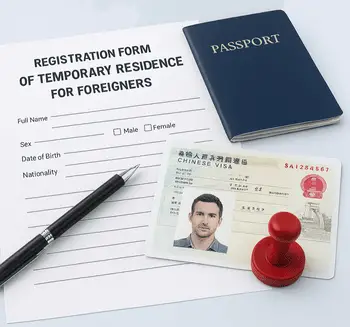
The cornerstone of this process is the official Registration Form of Temporary Residence.
This document records your personal details, visa information, and the details of your place of stay in China.
Its primary purpose is to maintain an accurate record of the whereabouts of all foreign nationals within Chinese territory for public security management.
Who Needs to Complete the Registration Form?
You must complete the temporary residence registration if:
- You are a foreign passport holder.
- You are staying in China for more than 24 hours in a location other than a licensed hotel.
- Your place of accommodation is a rented apartment, a privately-owned home, a friend’s or relative’s house, or any other non-hotel dwelling.
- You change your address within China, even if you previously registered at another location.
Exemption: As mentioned, hotel stays are exempt for the guest, as the hotel performs the registration.
The Step-by-Step Guide to Filling Out the Registration Form
The form, often bilingual (Chinese and English), must be completed accurately.
Below is a breakdown of each section.
Top of the Form – Administrative Details
This section is usually filled out by the police officer or the community office staff.
It includes the registration number, the date of registration, and the official stamp (Seal) of the local Police Station (PSB) or the community service center.
Part 1: Personal Details of the Registrant
This is where you provide your personal information.
Full Name
Write your name exactly as it appears on your passport. Use the English/Latin alphabet. Last Name (Surname/Family Name) first, followed by First Name (Given Name).
Sex
Mark the appropriate box: Male or Female.
Date of Birth
Format is typically YYYY-MM-DD. For example, January 15, 1985, would be 1985-01-15.
Nationality
Write your country of citizenship as it appears on your passport (e.g., American, British, Canadian, Australian).
Document Type & Number
This refers to your travel document. For most, it will be “Passport.” Write your passport number in the space provided.
Visa Type & Number
Indicate the type of visa you used to enter China (e.g., L-Tourist, Z-Work, X1-Student) and the visa number, which is the red number printed on the visa sticker/stamp.
Date of Entry & Port of Entry
The date you entered Mainland China (again, YYYY-MM-DD format) and the city/port where you entered (e.g., Shanghai Pudong International Airport, Beijing Capital International Airport, Hong Kong land border).
Duration of Stay in China
This is the validity duration of your current visa. For example, “000” for 0 years, “00” for 0 months, and “90” for 90 days.
Part 2: Details of Your Stay in China
This section links you to your accommodation.
Address of Stay
This is the most critical part. You must provide the complete and accurate address of where you are physically staying.
- Province/City/District: e.g., Shanghai Municipality, Xuhui District.
- Detailed Address: Include the street name, compound/building number, apartment building number, floor, and apartment/unit number. Example: “Room 1201, Building 15, Lane 1234 Huashan Road.”
Landlord/Host Information
You must provide the name and contact number of your landlord, the owner of the property, or the main tenant if you are subletting. If staying with a friend or relative, their information goes here.
Relationship with Landlord/Host
Check the appropriate box: Renting, Own Property, Friend/Relative, etc.
Part 3: Declaration and Signature
You will be required to sign and date the form, declaring that the information provided is true and accurate.
Required Documents for Registration
You cannot complete the registration with just the form. You must bring supporting documents.
Essential Documents Checklist
| Document | Purpose | Notes |
|---|---|---|
| Your Original Passport | Primary identity and visa verification. | Mandatory. |
| Original Visa & Entry Stamp | Proof of legal entry and status. | Inside your passport. |
| Landlord’s Original ID | Chinese ID card (Shenfenzheng) for citizens. | Mandatory for verification. |
| Property Ownership Proof | Property Ownership Certificate (Fangchan Zheng). | A photocopy is often required. |
| Rental Contract | If you are renting. | A signed copy. |
Sources: Compiled from requirements of Shanghai, Beijing, and Guangzhou Exit-Entry Administration Bureaus.
Note: Requirements can vary slightly by city and even by district. It is always advisable to check with the local community office first.
Where to Submit the Form: Registration Locations
You have several options for submitting your completed form and documents:
- Local Police Station (Pai Chu Suo): The traditional and most common venue.
- Community Service Center (Shequ Juweihui): In many cities, especially larger ones like Shanghai and Beijing, this decentralized office handles registrations for their immediate neighborhood.
- Online Platforms & Apps: Some cities offer online registration through official WeChat accounts or government apps. For example, Beijing has an online system, and Shanghai has also an online system while also promoting the “Suishenban” app. However, first-time registrations or complex cases may still require an in-person visit.
- Official Website: The National Immigration Administration (NIA) portal offers information and some online services. National Immigration Administration, PRC
It is crucial to find the specific police station or community office that has jurisdiction over the address where you are staying.
Common Mistakes and How to Avoid Them
Many applications face delays or rejections due to avoidable errors.
Top 5 Mistakes on the Registration Form
- Incomplete or Inaccurate Address: Using a P.O. Box or missing the apartment number. Provide the full, precise address.
- Passport and Visa Details Mismatch: Transposing numbers or misreading the visa type. Double-check against your physical passport.
- Missing Landlord Documentation: Arriving without the landlord’s original ID or property deed copy. Coordinate with your landlord beforehand.
- Missing the 24-Hour Deadline: While sometimes enforced leniently for first-time arrivals, it is a strict rule. Do not delay registration.
- Failing to Re-register After Moving: Every change of address requires a new registration at the new local police station.
Consequences of Non-Registration
The authorities take this requirement seriously.
Potential consequences include:
- Fines: Typically ranging from RMB 500 to RMB 2,000.
- Warning & Rectification Order: You will be ordered to register immediately.
- Negative Impact on Future Visa Applications: A record of non-compliance can lead to rejections or shorter visa validity for future applications within China.
- Detention: In severe or repeat cases, detention for up to 15 days is a legal possibility.
Special Scenarios and FAQs
Frequently Asked Questions
Q: I am staying with my spouse who is a Chinese citizen. What do I need?
A: The process is similar. You will need your spouse’s original Chinese ID card (Shenfenzheng), your marriage certificate (translated and notarized if issued abroad), and the property ownership proof for the address.
Q: What if my landlord refuses to provide their ID or go with me?
A: The landlord is legally obligated to assist. This is often stipulated in standard rental contracts. If they refuse, you may need to escalate through your rental agency or consider it a serious breach of contract. Without the landlord’s documents, registration at that address is nearly impossible.
Q: How do I get a copy of my registration form?
A: Upon successful registration, the officer will stamp a section of the form and often give you a perforated slip or a printed receipt as proof. Keep this slip safe. It is your proof of registration and is required for visa extension, residence permit applications, and sometimes for hotel check-ins. You can request a photocopy of the full stamped form.
Q: Is the process different for Hong Kong, Macau, and Taiwan compatriots?
A: The requirement is identical. Holders of Home Return Permits (Tongxingzheng) or other travel documents must also register when staying in private accommodation.
Conclusion: A Simple but Essential Task
Completing the Registration Form of Temporary Residence in China is a fundamental administrative task for any foreigner not in a hotel.
While it may seem bureaucratic, it is a straightforward process when you are prepared.
The key is to act within 24 hours, have all original documents ready, ensure your landlord is cooperative, and provide an exact address.
By following this guide, you can ensure your compliance with Chinese law, avoid unnecessary penalties, and enjoy a hassle-free stay.
Always remember to re-register every time you change your address or your passport number, keeping your legal status in China in good order.
About the Author